Gates Automation
Transform your manual gate into a modern automated system.
Gate Automation Podcasts
Listen to our expert discussions on gate automation, design tips, and best practices for California properties.

Your Guide to Gate Automation
Different types of automatic gate openers perfect for California homes.

Designing Your Perfect Gate
Tips on materials, aesthetics, and matching your gate to your property style.
Your Guide to Gate Automation in California
Welcome to your ultimate guide on automating your driveway gate! In sunny California, convenience, security, and style are paramount. We've put together this easy-to-read overview of the most popular gate automation types available.
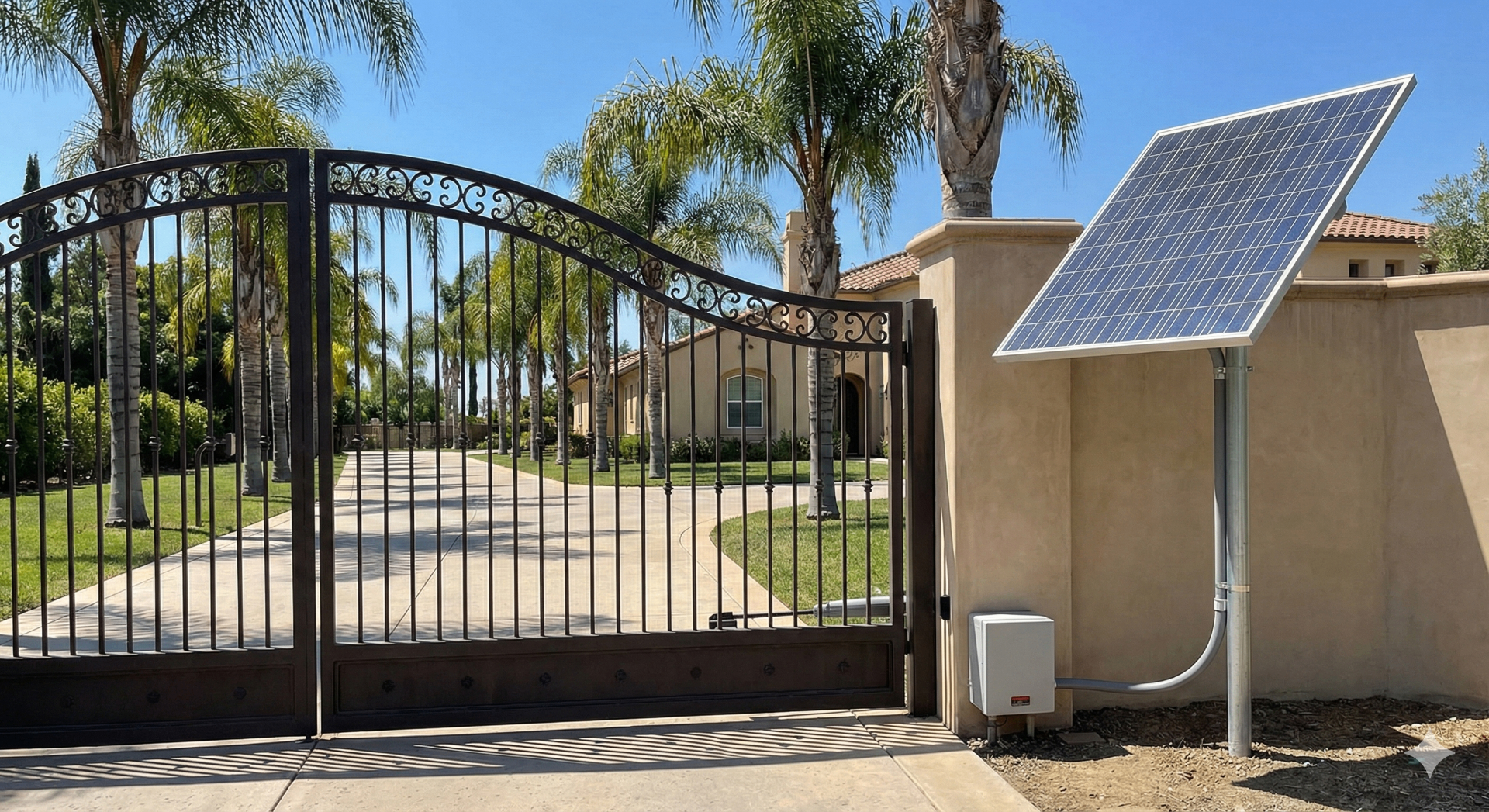
#1 The California Favorite: Solar-Powered Gate Openers
Given our state's abundance of sunshine, it's no surprise that solar-powered gate openers are a top choice. They are eco-friendly, can lower your energy bills, and are a fantastic solution for properties where running electrical lines to the gate is difficult or expensive.
A solar panel is a smart add-on for many gate types in California.
Key Features:
- Eco-Friendly & Cost-Effective: Harnesses free energy from the sun.
- Great for Remote Locations: No need for trenching long power lines.
- Works During Power Outages: The battery backup keeps it running.
- Versatile: Can be used with both swing and sliding gate systems.
#2 The Space-Saver: Sliding Gate Openers
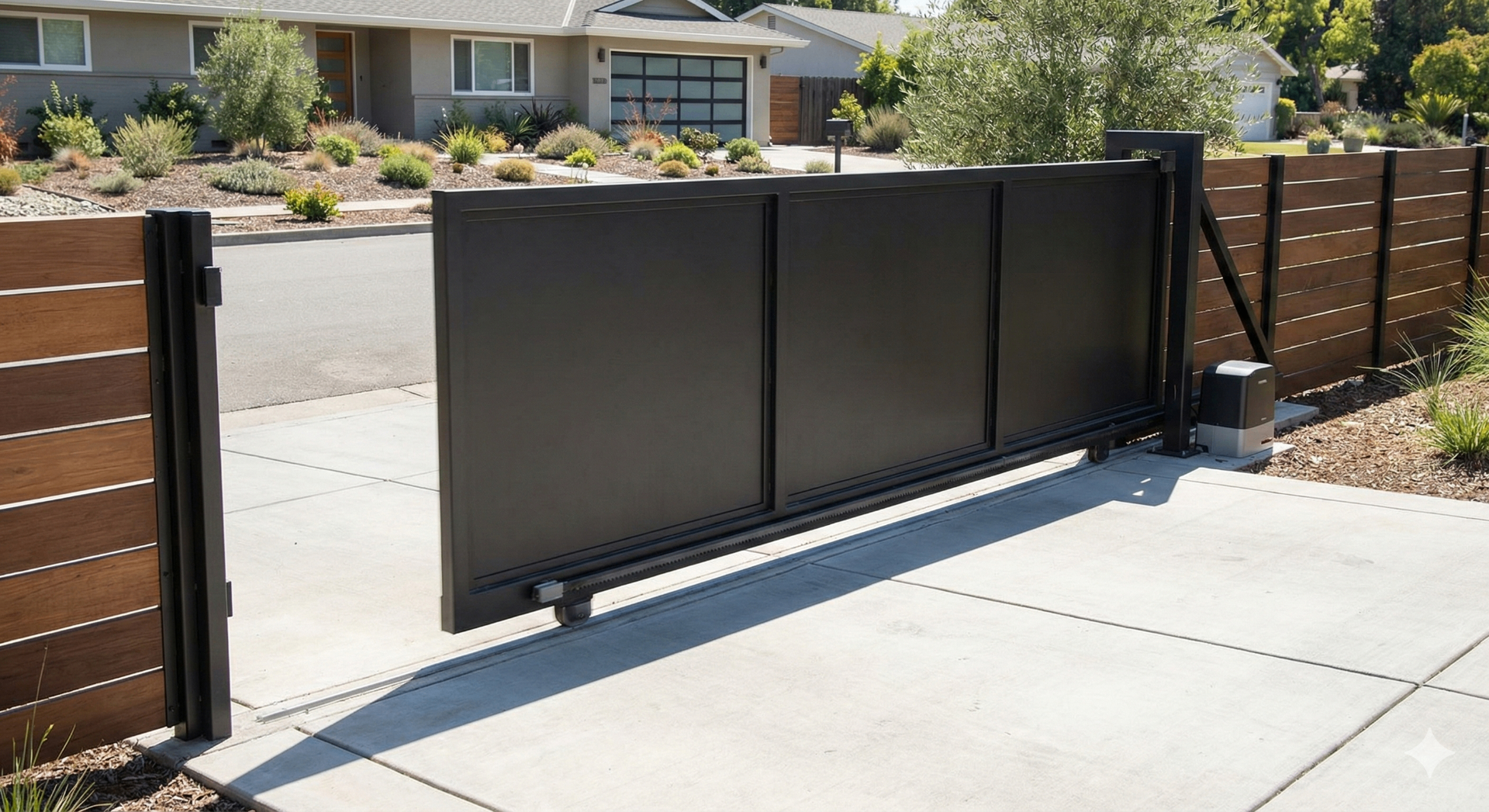
If you have a short driveway or limited space behind your gate, a sliding gate opener is an excellent and very popular option. Instead of swinging open, the gate runs horizontally along a track, hugging your fence or wall.
Sliding gates are perfect for properties with limited driveway space.
Key Features:
- Space-Efficient: Requires almost no room behind the gate to open.
- Secure: Difficult to force open, providing high security.
- Handles Heavy Gates: Ideal for large or heavy custom gates.
- Ideal for Slopes: Can be designed to work on a sloping driveway.
#3 The Classic Choice: Swing Gate Openers
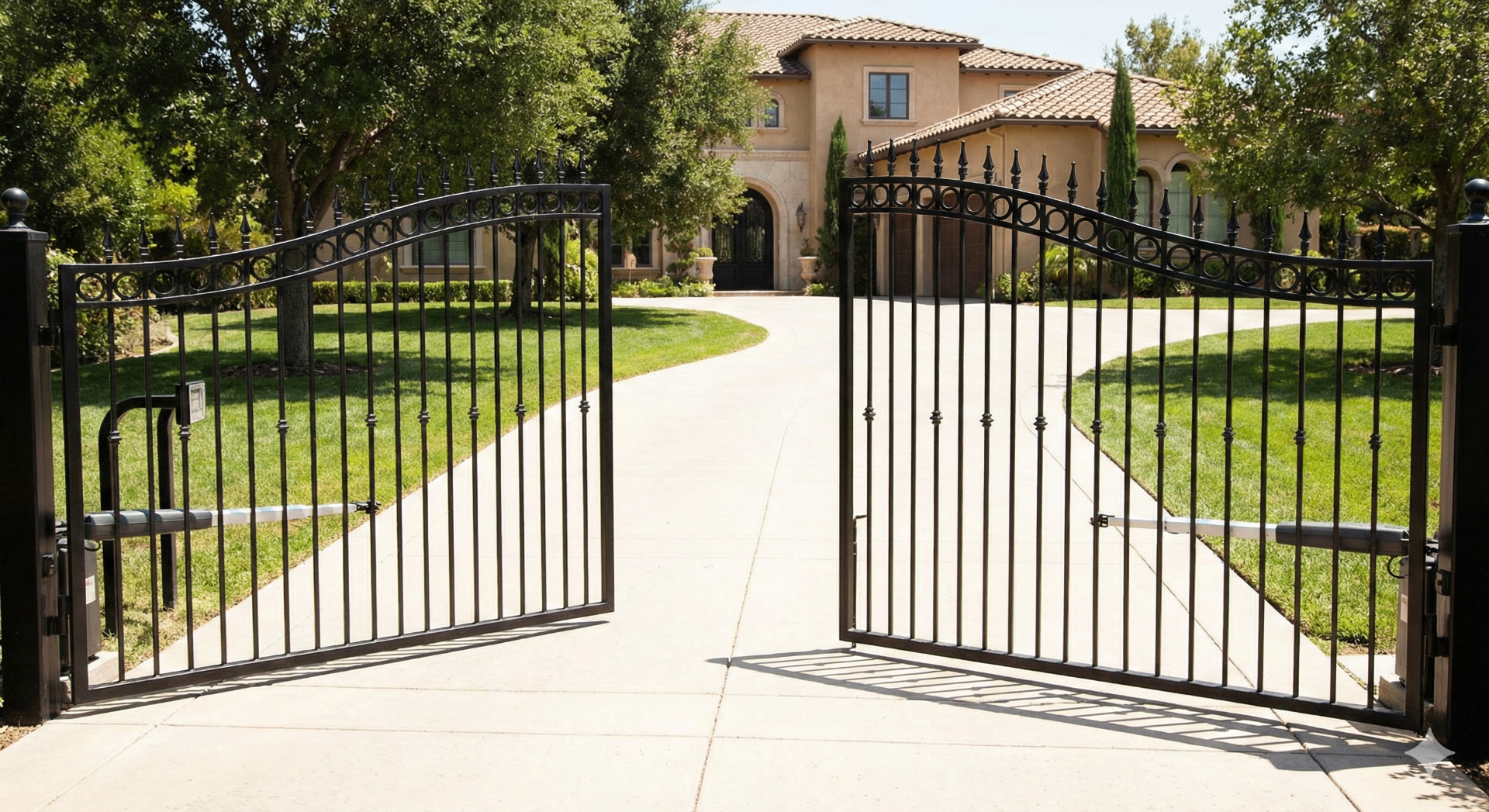
For properties with ample driveway space, the classic swing gate is a timeless and elegant choice. These gates open inward or outward just like a door. The most common type of opener is the linear ram, which uses an arm that extends and contracts.
Swing gates offer a traditional and grand entrance for properties with plenty of room.
Key Features:
- Classic Aesthetic: Provides a traditional, grand look.
- Simple Mechanism: Linear ram openers are generally simple and affordable.
- Articulated Arm Option: Available for gates with wide pillars or complex hinges.
- Requires Space: Needs clear space behind or in front for the full swing arc.
#4 The Hidden Gem: Underground Gate Openers
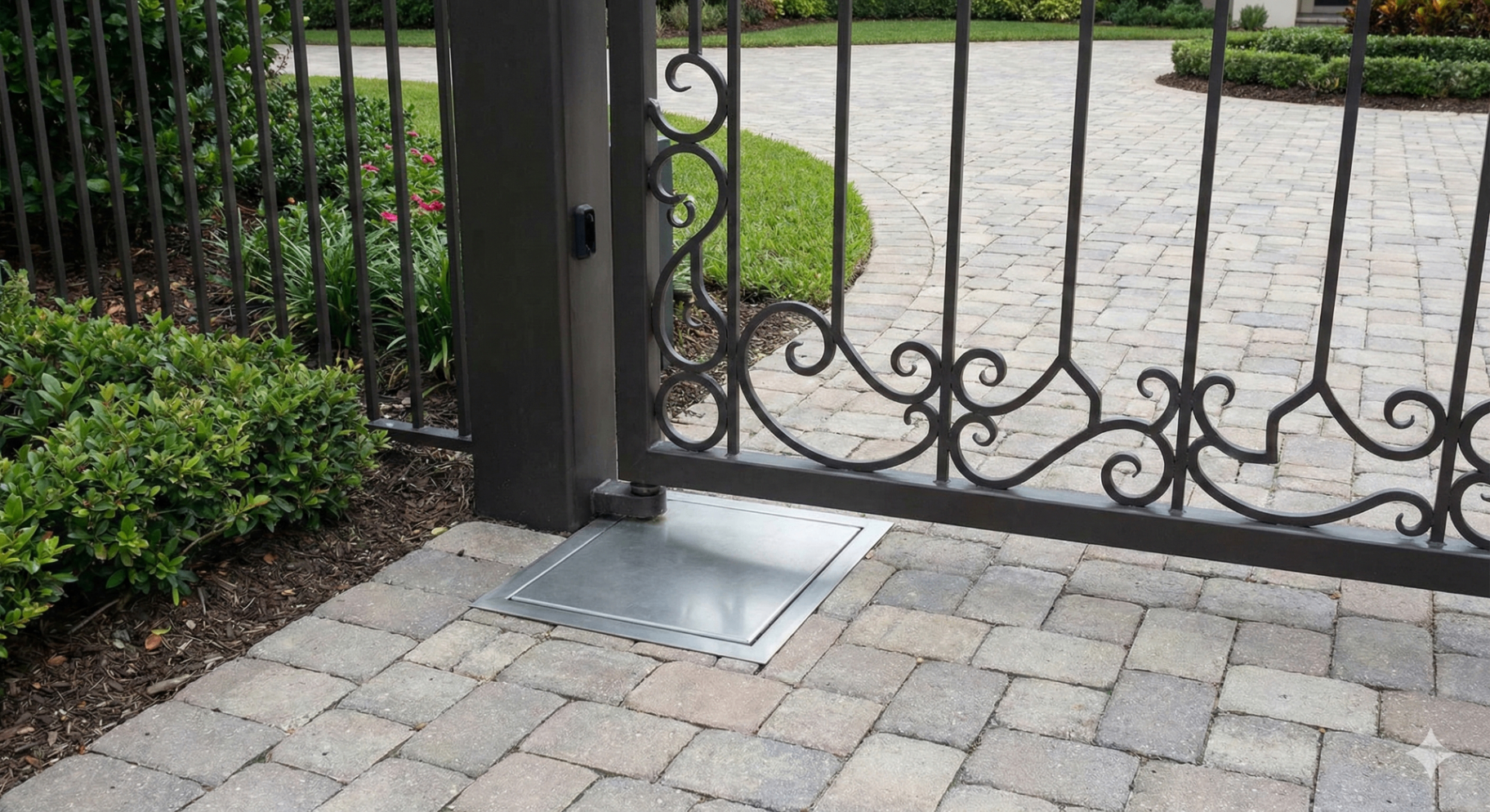
For the ultimate in aesthetics and discretion, you can't beat an underground gate opener. The entire motor mechanism is buried beneath the ground in a protective casing, with only a small arm connecting to the bottom of the gate.
An underground opener is virtually invisible, preserving the gate's design.
Key Features:
- Aesthetically Pleasing: The motor is completely hidden from view.
- Discreet: Maintains the clean lines of your gate design.
- Quiet Operation: The underground location can help dampen the motor's sound.
- Premium Option: Typically more expensive and complex to install.
#5 Specialized Solutions (The "Rare" Ones)
While the options above cover most residential needs, there are other, more specialized gate types you might encounter, often in commercial or high-security settings:
Cantilever Gates
Similar to sliding gates but do not run on a track on the ground. They are suspended and move on rollers attached to the fence post, making them a good choice for uneven ground or areas with snow or debris.
Vertical Pivot Gates
These gates rotate vertically to open, requiring very little side or back space. They are often seen in commercial storage facilities or industrial sites.
Overhead Gates
Much like a garage door, these gates lift vertically and slide into an overhead track. They are used in commercial buildings or parking garages where space is at a premium.
Sources:
The California Gate Automation Guide
A Comprehensive Analysis for Property Owners
Introduction: The Intersection of Security, Style, and Technology
In the varied landscape of California real estate, from the coastal enclaves of Malibu to the sprawling estates of the Sacramento Valley, the driveway gate has evolved from a simple barrier into a sophisticated node of the smart home ecosystem. It is the first handshake a property offers to a visitor and the primary line of defense against the outside world. For the modern California homeowner, navigating the complex market of gate automation is no longer just about buying a motor; it is about selecting a system that integrates with architectural aesthetics, withstands unique environmental stressors, and complies with rigorous safety standards.
The decision to automate a gate involves a convergence of mechanical engineering, electrical planning, and aesthetic philosophy. Whether the goal is to secure a modern steel fortress in Los Angeles or to automate a delicate wrought-iron entry in a historic district without ruining its visual lines, the equipment chosen must align with the specific "personality" of the entrance. This report serves as an exhaustive guide for potential customers, organized specifically to demystify the hardware options available.
The California Factor: Climate and Lifestyle
Before examining specific machinery, one must appreciate the operational theater. California presents a unique set of challenges that dictate equipment survival:
The Solar Advantage
With abundant Zone 1 and Zone 2 solar radiation, California is the premier market for solar-powered access, allowing gates to operate independently of the grid—a crucial feature during wildfire-season power shutoffs.
Coastal Corrosion
The salt air in coastal zones (within 5 miles of the ocean) acts as a slow solvent, devouring standard steel housings. Equipment here must be marine-grade or encased in heavy-duty composites.
The Heat Equation
Inland temperatures frequently exceed 100°F. Gate operators, particularly hydraulic ones, must be specified to handle thermal expansion and heat dissipation to prevent "thermal lockout" during heavy duty cycles.
Aesthetic Evolution
The trend in Los Angeles and the Bay Area is shifting toward "privacy" gates—solid wood or metal sheets. These act as sails during Santa Ana winds, requiring operators with immense holding force.
Section 1: Linear Ram Actuators – The Residential Standard
(The Most Popular Choice in California)
When you drive through the suburbs of San Diego or the residential hills of Oakland, the vast majority of swinging gates are powered by Linear Ram Actuators. These devices are the "Toyota Camry" of the gate world: reliable, cost-effective, and ubiquitous.
1.1 The Mechanics of the "Arm"
A linear ram is an arm-like device mounted to the gate post and the gate leaf. Its operation is conceptually simple but mechanically precise.
- The Screw Drive Concept: Inside the housing of a standard electromechanical ram (like the LiftMaster LA400), a threaded rod, known as a jackscrew, runs the length of the arm. An electric motor spins this rod. Because the screw pitch is fine, it provides a massive mechanical advantage, allowing a small motor to move a heavy gate.
- The Locking Effect: One of the primary reasons for the popularity of screw-drive rams is their inherent security. You cannot push a screw backward effectively. When the motor stops, the friction of the screw holds the gate firmly locked against wind or intruders, eliminating the need for a separate electric lock in many residential applications.
1.2 Comparison of Market Leaders
In the California market, three names dominate the conversation: LiftMaster, Viking Access, and DoorKing.
LiftMaster LA400PKGUL: The Ubiquitous Residential Hero
The LiftMaster LA400 is arguably the most installed gate operator in North America. It is a 24V DC electromechanical operator designed for gates up to 16 feet or 850 pounds.
Why it Wins: It hits the "sweet spot" of price and performance. It features MyQ technology built-in, allowing homeowners to control the gate from their smartphone without buying third-party add-ons.
LiftMaster LA500PKGUL: The Heavyweight Contender
For homeowners with modern, solid-faced privacy gates (which are heavier and catch more wind), the LA500 is the necessary upgrade.
Commercial DNA: Unlike the 400, the LA500 features a commercial-grade cast aluminum housing. It is rated for gates up to 18 feet or 1,600 pounds.
Viking Access G-5: The Coastal Warrior
Viking Access Systems, often favored by high-end installers, offers the G-5 linear operator.
Continuous Duty: The G-5 is rated for continuous duty cycles, meaning it can run 24/7 without overheating. This makes it ideal for HOAs or busy estates.
| Feature | LiftMaster LA400 | LiftMaster LA500 | Viking G-5 |
|---|---|---|---|
| Max Gate Weight | 850 lbs | 1,600 lbs | 2,000 lbs |
| Max Gate Length | 16 ft | 18 ft | 14 ft |
| Housing Material | Composite (Plastic) | Cast Aluminum | Cast Aluminum |
| Ideal Application | Standard Residential | Heavy/Windy Residential | HOA/Coastal/Solar |
| Tech Integration | Superior (MyQ) | Superior (MyQ) | Good (Modular) |
1.3 The Hydraulic Alternative (Ram)
While electromechanical screw drives rule the residential market, Hydraulic Rams (like the FAAC 400) occupy a prestige niche. Instead of gears, an electric pump pushes hydraulic fluid into a piston.
- The "Feel": Hydraulic operators are silent and incredibly smooth. There is no gear whine, just a whisper of fluid. They are often used on heavy, ornamental iron gates in historic districts like Pasadena or Hancock Park.
- The Maintenance Trade-off: Hydraulics have seals that can eventually leak. In the searing heat of the San Fernando Valley, hydraulic fluid expands, which necessitates careful adjustment of the bypass valves.
Section 2: Sliding Gate Operators – The Space Savers
(High Popularity in Urban and Hillside Contexts)
Sliding gates are the second most common type of automation in California. Their popularity is driven by two factors: Space and Topography. In the Hollywood Hills or San Francisco, where driveways are often steep inclines, a swing gate is physically impossible because it cannot swing "uphill" without scraping the ground.
2.1 The Two Schools of Motion: V-Track vs. Cantilever
The V-Track System (The Standard)
In 90% of residential installations, an angle-iron track is bolted to the driveway. Wheels welded to the bottom of the gate roll along this track.
Pros: Structurally simple and allows for a lighter gate frame.
Cons: Noisy and debris can derail the gate.
The Cantilever System (The Premium Choice)
A cantilever gate does not touch the driveway. It is suspended in the air, counterbalanced by a long "tail" section hidden behind the fence.
Why it's Better: Silent and immune to gravel, snow, and leaves.
The Cost: Requires a gate 50% longer than the opening.
2.2 The Equipment: Chain Drive vs. Rack & Pinion
- Chain Drive (The American Classic): Most sliding gate operators in the US (like the legendary DoorKing 9050/9150) use a chain drive. Chain drives are incredibly forgiving—if the ground settles and the gate wobbles, the slack in the chain absorbs the imperfection.
- Rack and Pinion (The European Style): Operators like the LiftMaster CSL24U can be set up with a "rack"—a toothed bar mounted to the gate. This system offers smoother start/stop motion and eliminates the "slap" of a loose chain.
2.3 Model Spotlight: The Battle for Dominance
DoorKing (DKS) 9050/9150
For decades, this has been the standard for California apartment complexes and homes. It uses a simple AC motor and a heavy steel chassis. Every gate technician in California carries DKS parts, making it the easiest machine to service.
LiftMaster CSL24U
The modern challenger. It uses a 24V DC motor, which runs cooler and quieter than AC motors. It can open at 12 inches per second, significantly faster than older models, and battery backup is essential for fire safety.
Viking L-3
Viking uses a unique positioning system that tracks the gate's location down to the millimeter. This is crucial for gates that need to interlock with a pedestrian gate or latch mechanism precisely.
Section 3: Articulated Arm Operators – The Geometry Solvers
(Niche Popularity for Large Columns)
As we move down the list of popularity, we encounter the Articulated Arm. This system is not a stylistic choice but a geometric necessity.
3.1 The Problem: The "Wide Pillar"
Imagine a grand entrance in Beverly Hills with massive stone columns, 24 inches square. The gate is hung on the center of this column.
- The Linear Ram Fail: If you try to mount a linear ram on this pillar, the geometry fails. The arm would hit the corner of the stone column before the gate is fully open.
- The Solution: The Articulated Arm functions like a human elbow. The motor sits on the back of the pillar, and a hinged arm reaches around the corner of the column to pull the gate open.
3.2 Mechanics and Aesthetics
- Scissor Action: The arm consists of a drive arm (attached to the motor) and a driven arm (attached to the gate). As the motor turns, the arm scissors open and closed.
- Speed: These are often faster than linear rams because the leverage changes dynamically throughout the swing.
3.3 Top Equipment
LiftMaster RSW12U
This is the gold standard for residential articulated arms. It can handle gates up to 16 feet and features an exceptionally smooth "soft start/soft stop" profile, which prevents the "clanking" often heard with older crank arms.
FAAC 390
A classic European electro-mechanical operator designed specifically for large pillars. It is often used on gates up to 1.8 meters per leaf and is known for its longevity and simple, serviceable design.
Section 4: Underground Operators – The Invisible Luxury
(Rare, Expensive, and Aesthetically Perfect)
At the top of the pyramid in terms of cost and aesthetics lies the Underground (or In-Ground) Operator. These are rare in standard tract homes but are the default choice for high-end custom estates where the visual integrity of the gate is paramount.
4.1 The "Invisible" Appeal
With a linear ram or articulated arm, you see the machinery. A black box, a silver arm, wires—it creates visual clutter. With an underground system, the mechanism is buried beneath the driveway in a steel foundation box. The only visible part is a small steel plate at the base of the hinge. The gate appears to move by magic.
4.2 The Installation Challenge
The rarity of these systems is due to the difficulty and cost of installation.
- Excavation: The installer must jackhammer the driveway and dig a precision hole for the foundation box.
- Alignment: The output shaft of the motor must be perfectly aligned with the top hinge of the gate. If it is off by even a fraction of an inch, the gate will bind and destroy the bearings.
- Drainage (The Critical Factor): The foundation box is essentially a bucket buried in the ground. If it fills with water, the motor will eventually corrode. A mandatory requirement is a dedicated drain line plumbed to a soak pit or sewer.
4.3 The Equipment: FAAC 770
The FAAC 770 is the undisputed king of this category. It is a 24V electromechanical operator that can open gates up to 110 degrees standard, or up to 180 degrees with a special chain-drive accessory kit—something a linear ram physically cannot do. Because the motor is geared heavily, it has immense crushing power. Modern versions utilize virtual encoders to detect obstructions and reverse immediately, complying with UL 325.
Section 5: Solar Automation – The California Superpower
(A Critical Feature for the Golden State)
While "Solar" is a power source rather than a mechanical type, in the consumer's mind, it is a distinct category. California is uniquely positioned to maximize this technology.
5.1 The "Tax Credit" Reality
The federal solar tax credit (ITC) often applies to the entire cost of the gate installation if the primary purpose of the automation is solar-driven. This 30% credit has driven a massive surge in solar gate adoption across the state, from ranches in the Central Valley to eco-conscious homes in Marin County.
5.2 The Engineering of Solar: Watts vs. Standby
The secret to a reliable solar gate is not just the solar panel; it is the Standby Current Draw—the "vampire load" the circuit board consumes while listening for a radio signal.
US Automatic (Patriot Model)
This brand is legendary in the solar space because their control boards have an incredibly low standby draw (micro-amps). They are designed for rural longevity. A small 6-watt panel can often run a Patriot gate indefinitely.
LiftMaster
While LiftMaster units (LA400/500) are "solar ready," their boards are feature-rich (MyQ, safety loops, etc.), resulting in a higher baseline power draw. To run a LiftMaster on solar, you typically need a significantly larger panel (20W-40W).
5.3 Calculating Your Needs
For a potential customer in California, the math is generally favorable. Most of CA is in Solar Zone 1 (maximum sun). The Rule of Thumb: 10 Watts of panel per 10 cycles of the gate per day. If you open your gate 20 times a day, a 20-Watt panel is the safe baseline. However, if you add a keypad (which has lights) or an intercom, you must double your panel size.
Section 6: Safety and Compliance – UL 325
(The Non-Negotiable Requirement)
An automated gate is a piece of heavy industrial machinery. In the past, injuries were common. Today, stringent standards (UL 325 and ASTM F2200) dictate how these systems must be installed.
6.1 The "Two Means" of Protection
Since 2018, every gate operator sold in the US must have two independent ways to detect an obstruction for every direction of travel.
- Inherent Sensor (Type A): The motor itself "feels" the gate. If it hits a car, the amperage spikes, the computer detects the spike, and reverses the gate.
- External Sensor (Type B1/B2): This is usually a Photo Eye (a beam of light across the driveway). You generally need one set for opening and one set for closing.
6.2 Entrapment Zones
- Slide Gates: The most dangerous area is the "draw-in" zone where the gate slides back alongside the fence. This area must be screened with mesh or protected by contact sensors (safety edges).
- Swing Gates: The "pinch point" at the hinge is capable of severing fingers. If the distance between the open gate and a wall is less than 16 inches, it is a crush zone and must be protected.
6.3 Fire Department Access
In California, compliance with the local Fire Marshal is strict.
- Knox Box: A keyed switch that allows fire crews to open the gate with a master key.
- Strobe Sensors: Some districts require a sensor that detects the specific strobe frequency of an emergency vehicle, opening the gate automatically.
- Fail Safe: Solar gates generally must be set to "Fail Safe"—meaning if the battery dies completely, the gate unlocks and can be pushed open by hand.
Section 7: Costs and Maintenance
(The Long-Term View)
7.1 Installation Cost Analysis
$3,500 - $5,500
Entry Level
Single swing gate with LiftMaster LA400, solar panel, and basic safety eyes.
$6,000 - $9,000
Mid-Range
Dual swing gate or standard sliding gate with Viking or DoorKing operator.
$15,000+
High-End
Custom underground operators (FAAC 770), masonry, extensive loop detectors, smart home integration.
7.2 Maintenance: The California Reality Check
- Insects: A surprising number one cause of failure in CA is insects. Ants and spiders love the warmth of the control board. Sealing the box with silicone and using pest repellents is a standard pro tip.
- Chain Maintenance: For sliding gates, the chain stretches over time. It needs to be tightened annually. Use a heavy-duty Chain Lube spray (like motorcycle chain wax) that dries tack-free—do NOT use grease.
- Photo Eye Cleaning: The lenses of the safety sensors get dirty from dust and sprinkler overspray. A simple wipe with a microfiber cloth solves 50% of "broken gate" service calls.
Conclusion
Choosing the right gate automation for a California property is a balance of form and function.
- For the standard residential driveway, the Linear Ram (LiftMaster LA400) is the undisputed champion of value and reliability.
- For tight spaces or steep driveways, the Sliding Gate (DoorKing or LiftMaster) is the problem solver.
- For grand estates where aesthetics rule, the Underground Operator (FAAC) offers invisible luxury.
- For rural or off-grid applications, US Automatic provides the solar efficiency required for peace of mind.
By understanding these categories, property owners can move forward with a system that not only secures their home but enhances its value and functionality for decades.
Detailed Comparison: Popular Gate Automation Specifications
The following table provides a direct comparison of the most popular models available in the California market.
| Model | Type | Voltage | Max Weight | Max Length | Solar Ready? | Best Feature |
|---|---|---|---|---|---|---|
| LiftMaster LA400PKGUL | Linear Ram | 24V DC | 850 lbs | 16 ft | Yes (Kit) | MyQ Smartphone Control included |
| LiftMaster LA500PKGUL | Linear Ram | 24V DC | 1,600 lbs | 18 ft | Yes (Kit) | Commercial-grade durability |
| Viking G-5 | Linear Ram | 24V DC | 2,000 lbs | 14 ft | Native | Continuous duty; high solar efficiency |
| US Automatic Patriot | Linear Ram | 12V DC | 650 lbs | 16 ft | Native | Lowest standby power draw |
| DoorKing 9050 | Slide (Chain) | 115V AC | 1,000 lbs | 30 ft | No | Bomb-proof mechanical reliability |
| LiftMaster CSL24U | Slide (Chain) | 24V DC | 1,500 lbs | 50 ft | Yes | High speed; battery backup; smart |
| LiftMaster RSW12U | Articulated | 24V DC | 1,000 lbs | 16 ft | Yes | Soft start/stop protects iron gates |
| FAAC 770 | Underground | 24V DC | 1,100 lbs | 11.5 ft | Possible | Invisible installation; aesthetics |
Troubleshooting Guide: Common California Gate Issues
Even the best equipment encounters issues. This guide addresses the most frequent problems reported by California homeowners.
1. The Gate Won't Close (Sunny Day Syndrome)
Symptom: The gate opens fine but refuses to close. You hear clicking or beeping.
Cause: Sunlight glare. The low angle of the sun can shine directly into the photo eye safety sensor, "blinding" it.
Fix: Swap the photo eyes so the receiver faces away from the sun, or install sun shields (hoods) over the sensors.
2. The "Ghost" Opening
Symptom: The gate opens randomly on its own, often at night.
Cause: Dirty keypad (moisture bridging contacts) or loop detector noise (shifting ground or failing insulation).
Fix: Disconnect accessories (keypad, loop) one by one from the control board to isolate the faulty device.
3. Squeaking and Grinding (Sliding Gates)
Symptom: A loud screeching noise during operation.
Cause: Dry chain or worn rollers.
Fix: Do NOT use grease—it attracts dust. Use a heavy-duty Chain Lube spray that dries tack-free. Inspect wheel bearings and replace in pairs if wobbling.
4. Solar Battery Failure in Winter
Symptom: The gate works during the day but moves slowly or stops at night in December/January.
Cause: Insufficient solar gain—shorter days and lower sun angle. Tree growth may now shade the panel.
Fix: Trim vegetation shading the panel. Check battery age (3-4 year lifespan in CA heat). Consider upgrading to a higher wattage panel.
Deep Dive: The Tech Behind the Motion
Smart Homes and the Connectivity Revolution
The days of the simple "clicker" are numbered. The integration of gates into the smart home is a primary driver for new installations.
- MyQ (Chamberlain/LiftMaster): This proprietary ecosystem is the market leader. It provides status alerts ("Gate left open" notifications) and allows for "Amazon Key" integration, where verified delivery drivers get one-time access to drop packages inside the gate.
- Cellular Intercoms: Systems like DoorBird or ButterflyMX are replacing old telephone entry systems. A homeowner in Los Angeles can see a visitor at their gate while vacationing in Europe and buzz them in remotely.
Loop Detectors: The Invisible Doorman
Buried beneath the asphalt of the driveway are loops of wire that act as metal detectors.
- Exit Loop: Buried 50-100 feet inside the property. When you drive over it, the change in magnetic inductance triggers the gate to open—the seamless "hands-free" exit experience.
- Safety (Reverse) Loop: Buried in the swing path of the gate. If a car is sitting on this loop, the gate cannot close—a backup to the photo eyes.
- Shadow Loop (Center Loop): Used for swing gates, located right under the gate swing. It ensures the gate doesn't close if a car is straddling the threshold.
Final Thoughts for the Buyer
The journey to automation is an investment in the property's future. By understanding the hierarchy of equipment—from the reliable Linear Ram to the sophisticated Underground system—and acknowledging the realities of the California environment, property owners can make decisions that transcend simple utility.
A well-chosen gate system is silent, secure, and seamless. It integrates into the daily rhythm of life, opening when needed and securing when closed, powered by the sun and connected to the cloud. Whether purely functional or architecturally invisible, the right equipment exists. The key is simply matching the machine to the mission.
Preview your automated gate
Share a photo of your driveway and describe the swing or slide gate you want. The AI studio places a concept of it on your own property so you can compare ideas.